
La Alianza Domestic Worker Surveys - 2026 Q1 Report
UNEMPLOYMENT PERSISTS AS CRISIS CONDITIONS EASE
Modest improvements in conditions for Spanish-speaking domestic workers overshadowed by persistent unemployment and economic vulnerabilities in Q1 2026
April 2026
After an incredibly turbulent year in 2025, domestic workers navigated a volatile labor market alongside the rest of the workforce at the start of 2026. Patterns of non-existent job creation and protracted unemployment mirrored difficulties reported by domestic workers in recent months.
The National Domestic Workers Alliance (NDWA) has been surveying Spanish-speaking domestic workers since March 2020 and, in the last half of 2025, these workers reported record-high economic insecurity, deteriorating employment and job conditions, and a spike in poor mental health. Whether these crisis conditions would further erode, solidify, or show signs of recovery at the start of the new year was an open question.
This report finds that conditions for Spanish-speaking domestic workers showed some improvements in the first quarter of 2026 compared to the last two quarters, but that conditions today were still on par with or worse than conditions one year ago.
Summary
Unemployment among Spanish-speaking domestic worker respondents far surpassed national estimates, with 14% reporting zero hours worked in the last week despite being available for and actively looking for work.
Among those who worked fewer hours than they wanted, 67% reported difficulties finding clients and 11% reported not feeling safe enough to work more hours.
Economic vulnerabilities persisted among respondents, with 59% reporting difficulties paying for household expenses and 52% reporting missed rent or mortgage payments.
One in two (50%) respondents reported poor psychological well-being.
Nearly one-third (29%) of respondents had a written contract for at least one job.
Of the 577 survey respondents who participated in a special survey in February, only 70% had at least one paid job as a domestic worker in the previous three months.
Data overview
This report analyzes 2,253 complete responses from 1,733 Spanish-speaking domestic workers to one or more of the 6 biweekly surveys conducted via La Alianza between January and March of 2026 (Q1 2026).
Employment situation
Domestic worker unemployment far surpassed the national unemployment rate. In Q1 2026, 14% of Spanish-speaking domestic worker respondents were unemployed, meaning they had worked zero hours in the last week but were available for and actively looking for work. By comparison, in March, the national unemployment rate was 4.3% and the unemployment rate among Hispanic women aged 20 years and older was 5.1%.
Modest improvements in employment overshadowed by persistent underemployment. The percent of respondents who were employed with adequate hours increased to 27% in Q1 2026 from 23% in Q4 2025. Nonetheless, the share of adequately employed respondents was still higher one year ago, at 32% in Q1 2025 (Figure 1).
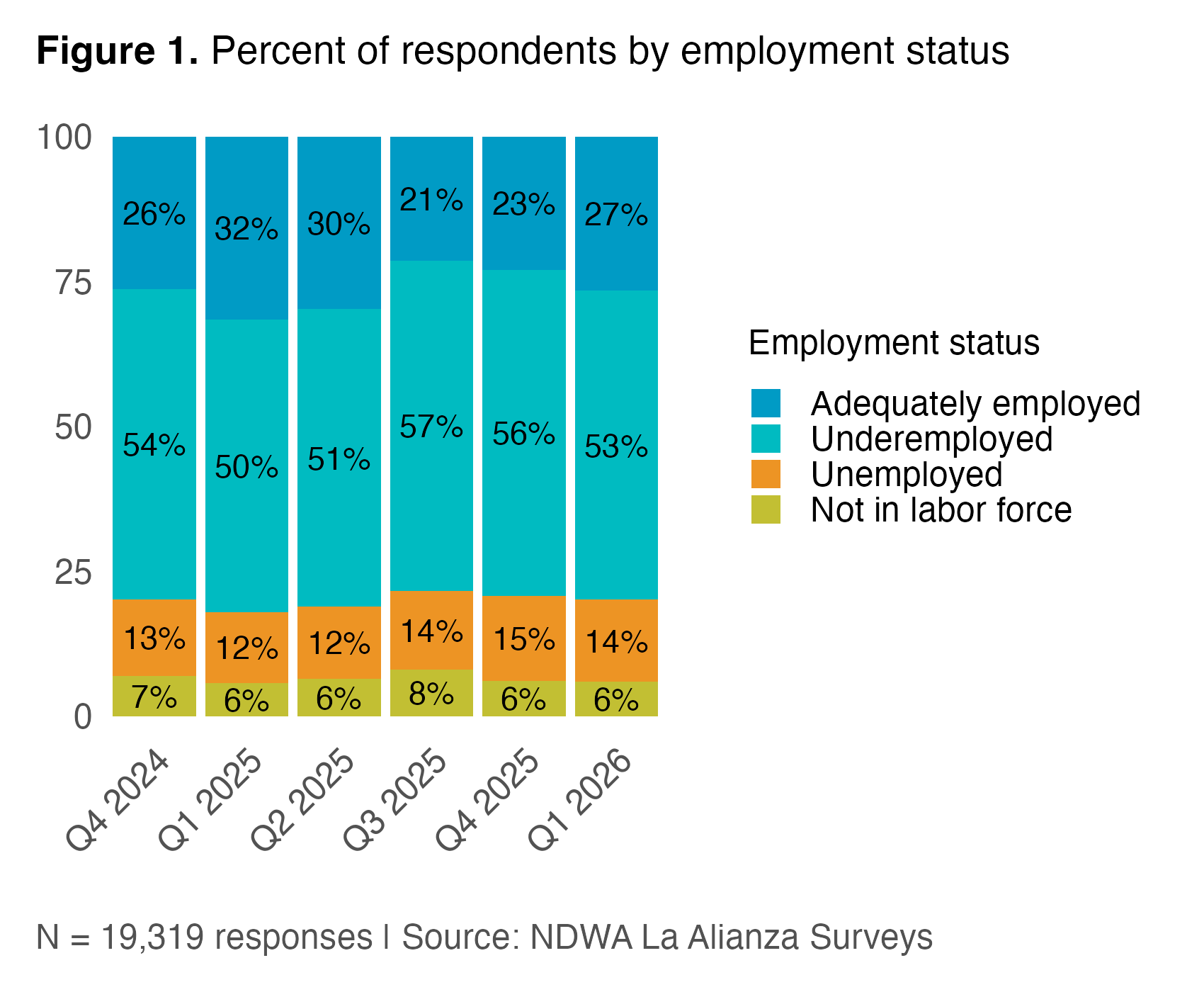
Meanwhile, the percent who were underemployed—meaning they worked fewer hours than they wanted—stood at 53% in Q1 2026, recovering slightly from 56% in Q4 2025.
When asked why they couldn’t work more hours, 67% of respondents reported difficulties finding clients. An additional 11% reported not feeling safe enough, followed by 10% reporting a health problem, 5% taking care of a family member, and 7% selecting “Other”.
The remaining 6% of domestic worker respondents were not in the labor force in Q1 2026, falling just below the 18-month average of 7% labor force non-participation. Finally, 45% of domestic worker respondents were paid $14 or less per hour in Q1 2026.
Economic security
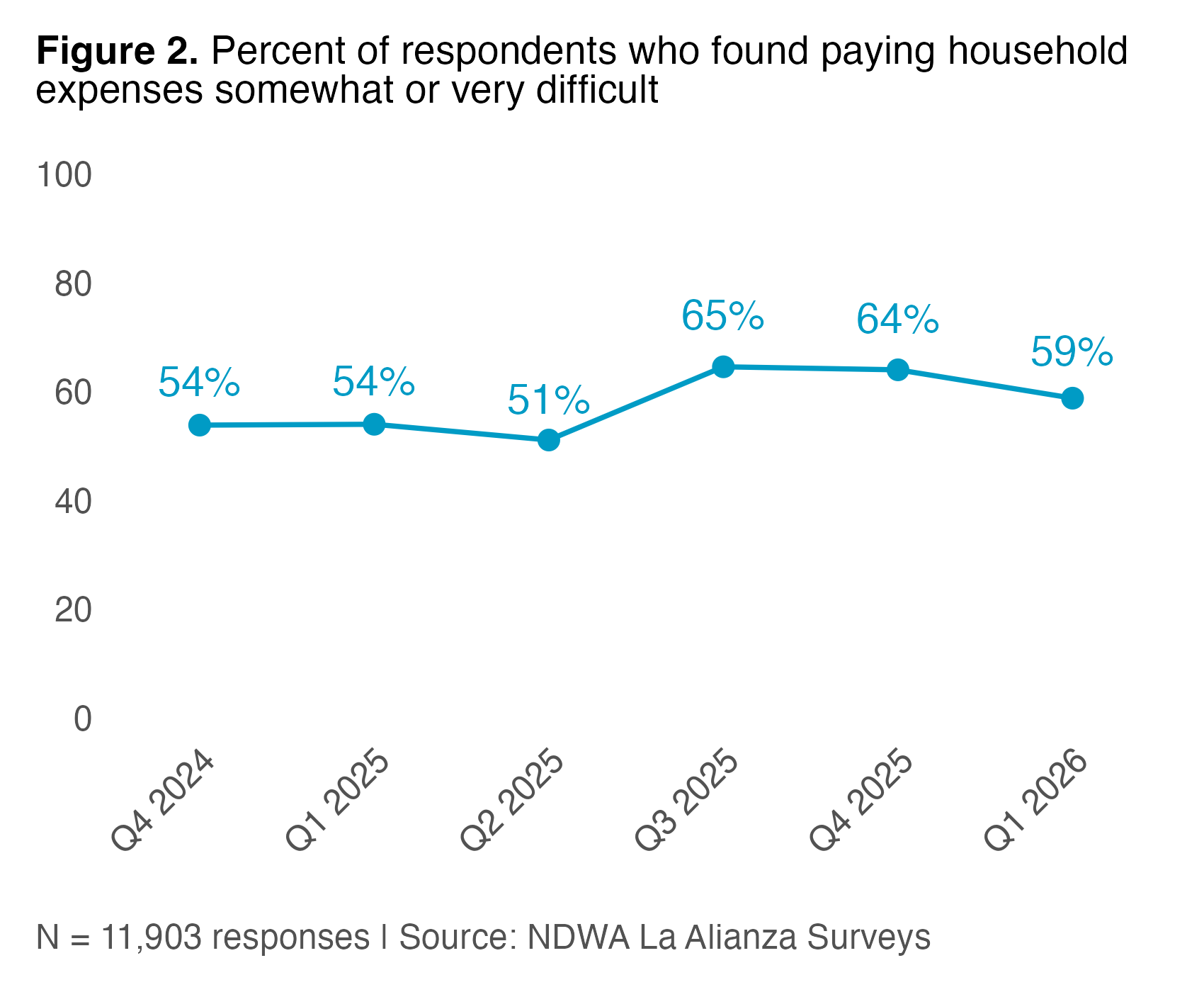
A return from economic crisis to economic vulnerability. In Q1 2026, nearly 6 in 10 (59%) domestic worker respondents found it somewhat or very difficult to pay for regular household expenses. Fifty-two percent were unable to pay their rent or mortgage on time, and 82% reported that food was sometimes or regularly scarce in their household in the last 7 days.
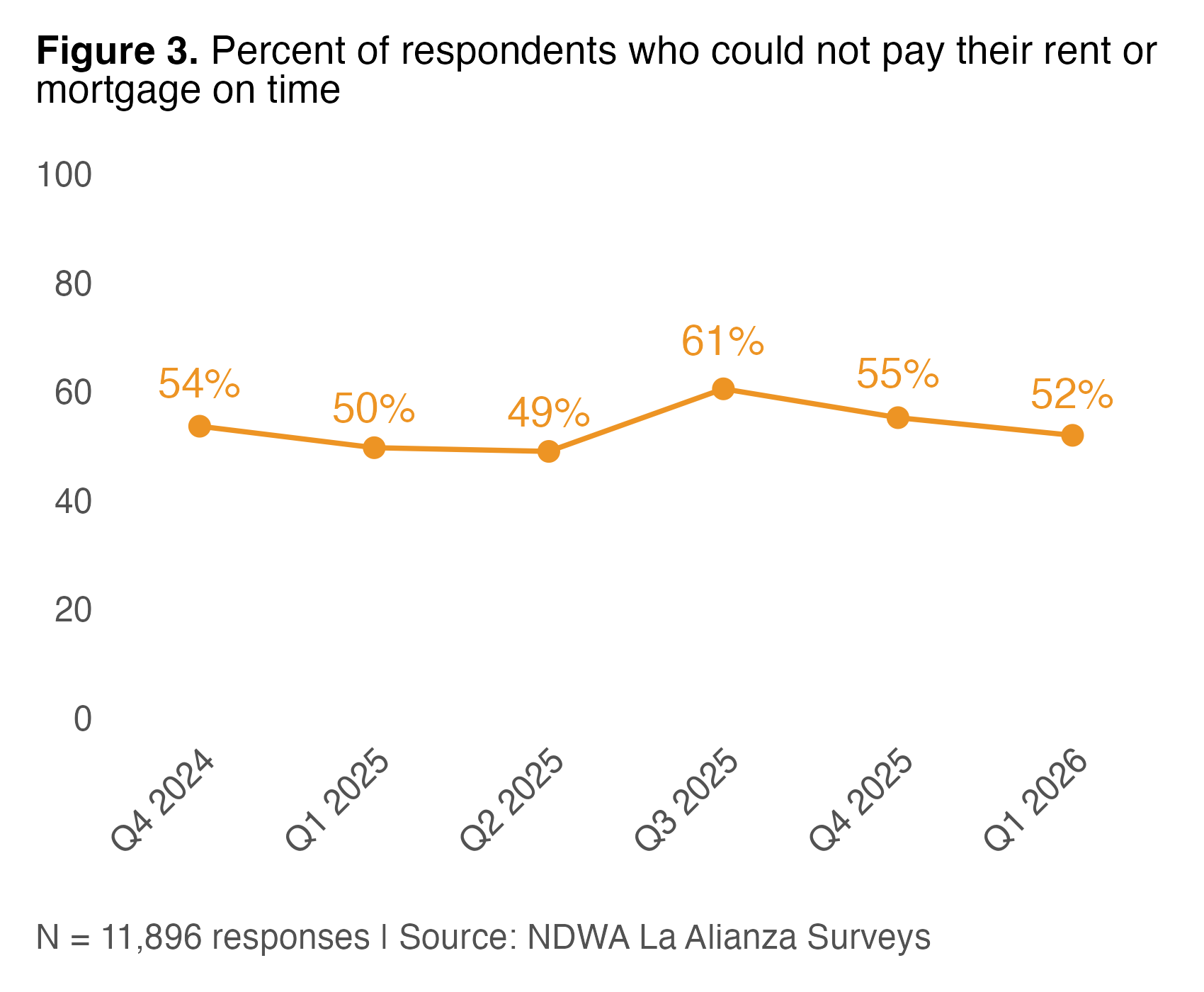
Despite improvements from the last two quarters, all three measures are still worse than they were one year ago (Q1 2025), when 54% of respondents reported economic insecurity, 50% reported housing insecurity, and 81% reported food insecurity (Figures 2 and 3).
Mental health and working conditions
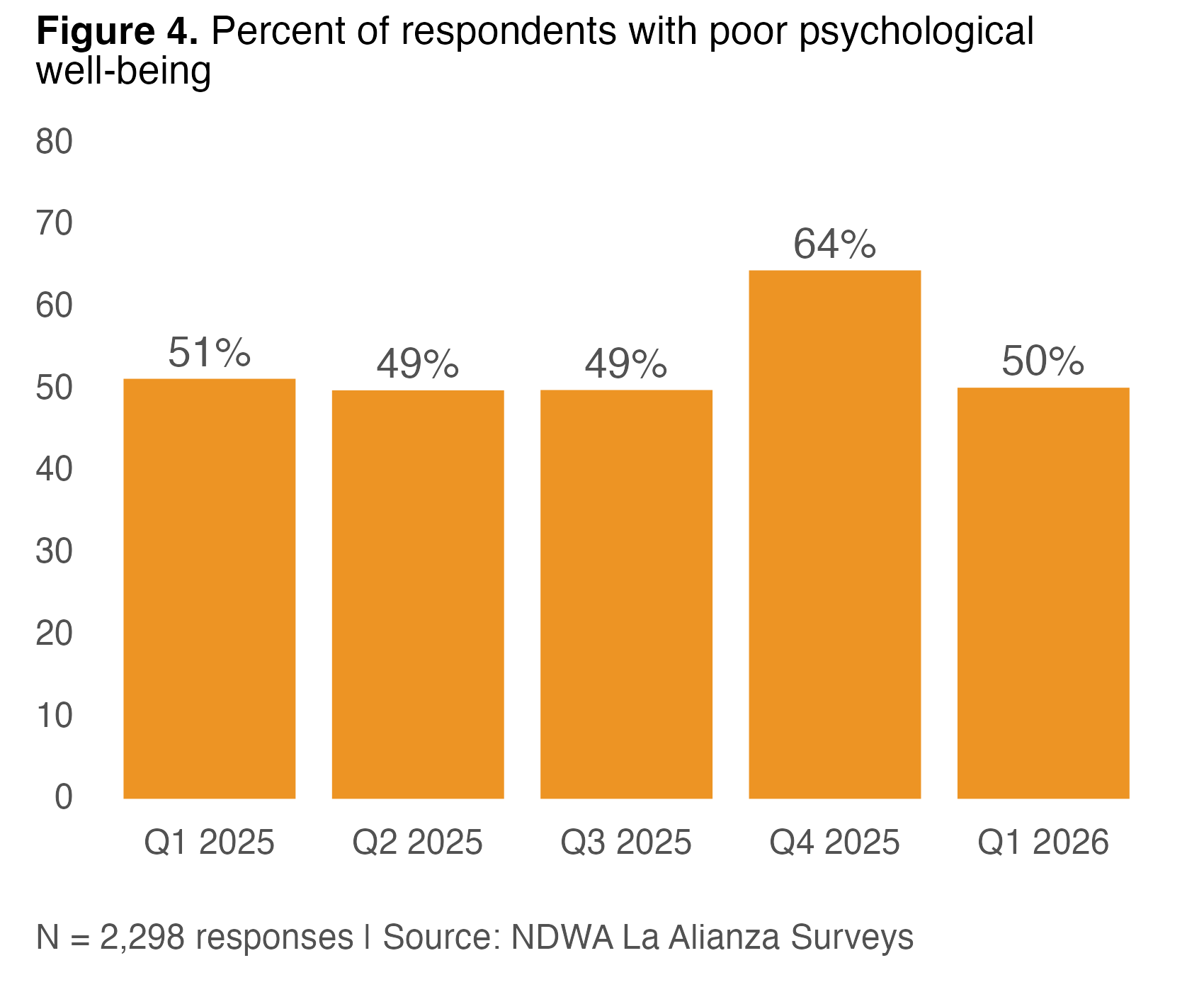
Poor psychological well-being returned to pre-crisis levels. The percent of respondents who reported poor psychological well-being fell from 64% in Q4 2025 to 50% in Q1 2026 (Figure 4), returning to levels on par with those from earlier in 2025 (49-51% in Q1-Q3 2025). Despite this notable improvement from last quarter, the fact that 1 in 2 domestic worker respondents still report mental health poor enough to warrant further mental health screening remains concerning. Psychological well-being is measured quarterly and scored using this threshold from the World Health Organization.
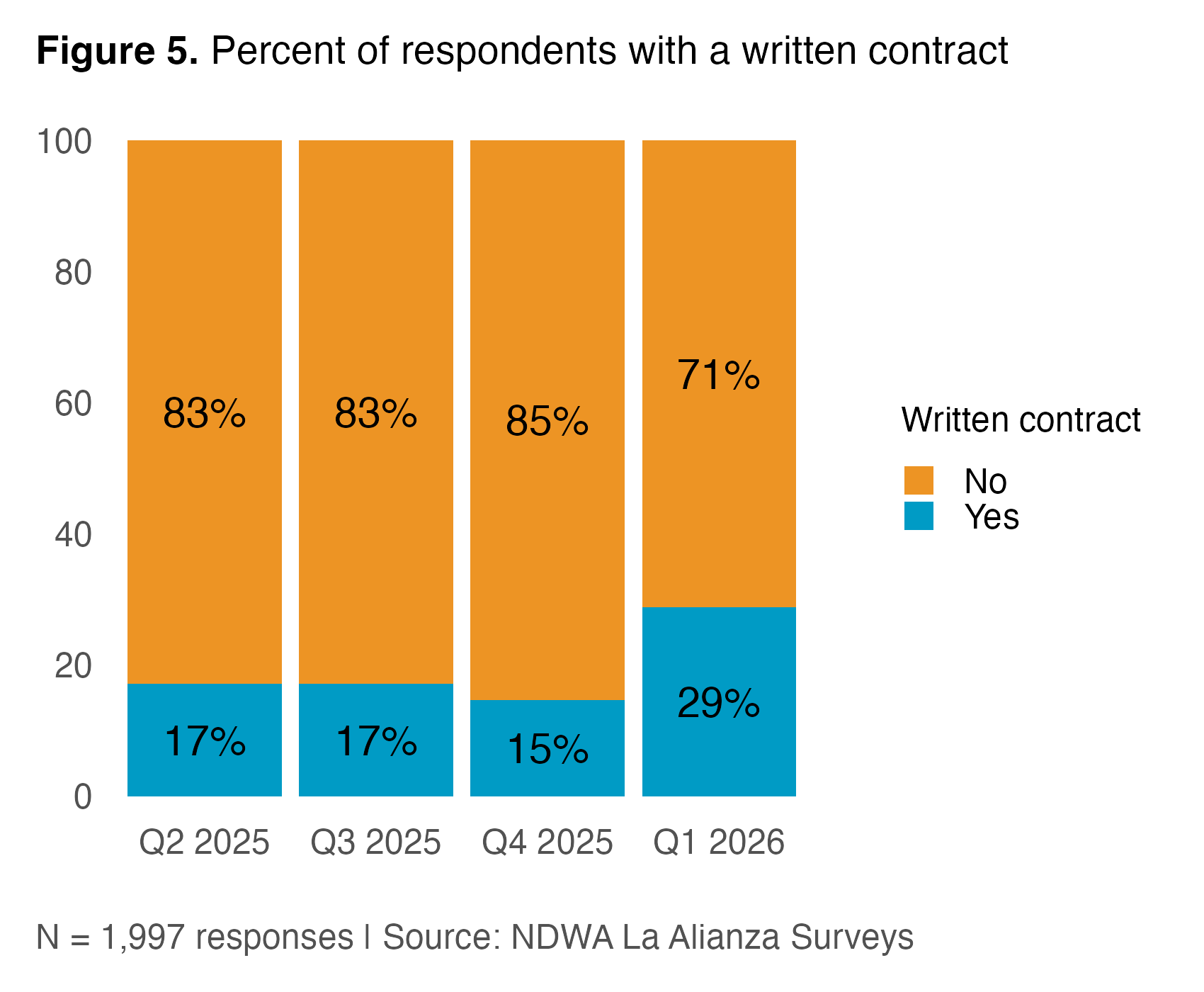
Unexpected improvements in some aspects of job quality. In Q1 2026, 29% of respondents reported having a written contract for at least one job (Figure 5). This is nearly double the 15% of respondents who responded similarly in Q4 2025. Moreover, 48% of respondents felt somewhat or very comfortable asking for a sick day in Q1 2026, improving from 36% in Q4 2025 yet returning to similar levels from Q1-Q3 2025.
Other aspects of job quality, however, remained stable. For example, 35% of respondents reported regularly having health or safety concerns at work in the last three months, compared to 33% in Q4 2025.
Although we cannot determine the reasons for these patterns of job quality results from survey data, the increased share of respondents reporting a written contract and comfort asking for sick days could be related to workers starting new jobs, establishing new contracts, and/or revisiting old contracts at the start of a new year. We only began asking consistent questions about job quality in Q2 2025, meaning that this is the first time we are observing how responses may change at the start of a new year.
Job loss
In February, we administered a special survey to all reachable Spanish-speaking domestic workers subscribed to La Alianza. Survey questions included whether respondents had recently worked as domestic workers, their primary occupation, years of experience, and new industry if not currently working in the domestic workforce.
Of the 577 people who responded to this special survey, only 70% had at least one paid job as a domestic worker in the last three months (November 2025-February 2026). Among respondents without a recent domestic work job, 60% had no job at all in the last three months.Others had found different work, with the most common industry being office cleaning (16% of respondents).
Among respondents who had paid domestic work jobs recently, 70% worked primarily as house cleaners, 16% as home care workers, and 14% as nannies. Over one-third (36%) of respondents had 11 or more years of experience in that type of domestic work.
Why this matters
In 2025, Spanish-speaking domestic workers weathered the worst employment and economic crisis since the COVID-19 pandemic. Now, in the first three months of 2026, heightened underemployment, economic insecurity, and mental health challenges may finally be easing.
However, a single quarter of only partial recovery does not negate the harm that this administration’s policies have caused domestic workers. Throughout 2025, domestic workers participating in peer interviews and group discussions voiced concerns around the downstream effects of widespread economic uncertainty on their livelihoods. At the time of these discussions, employers had already begun firing workers, committing wage theft, and cutting back on housecleaning services seen as “luxury” expenses they could no longer afford.
As the economy barrels towards continued volatility, domestic workers have little protection from future economic downfalls. Following years of low wages and a systemic reversal of post-pandemic recovery, it is paramount to continue monitoring and calling attention to the well-being of America’s domestic workforce.
Methodology
Surveys are administered every two weeks to a rotating subset of ~40,000 La Alianza subscribers via Facebook Messenger. A response is considered complete when a respondent answers all survey questions and reaches either the intake or resource module, where demographic information is collected and relevant resources for domestic workers are shared, respectively.
Prior to this report, a response was considered complete only when respondents reached the resources module. This report updated this definition to capture respondents who completed survey questions but stopped responding when asked demographic information.
To learn more about NDWA’s La Alianza survey, see our methodology report here.
Key terms
Employment status is defined using information on the number of hours worked in the last 7 days, attitudes towards hours worked, availability for work in the last 7 days, and whether a respondent looked for a job in the last 30 days:
Adequately employed: Worked >0 hours; Worked the number of hours they wanted or more hours than they wanted
Underemployed: Worked >0 hours; Wanted to work more hours than they did
Unemployed: Worked 0 hours; Available to work and tried to find work
Not in labor force: Worked 0 hours; Not available to work and/or did not look for work
Quarters are defined as follows: Q1 = January-March, Q2 = April-June, Q3 = July-September, and Q4 = October-December.