
La Alianza Domestic Worker Surveys - 2026 Q2 Report
UNEMPLOYMENT EASES, YET WORKER VOICE GAPS REMAIN
Unemployment fell modestly as conditions for spanish-speaking domestic workers were otherwise stagnant in q2 2026
august 2026
The National Domestic Workers Alliance (NDWA) has been surveying Spanish-speaking domestic workers since March 2020 to track employment conditions and economic trends over time. During the second half of 2025, survey results showed that workers were grappling with record-high economic insecurity, deteriorating employment and job conditions, and a spike in poor mental health. Worker testimonies from 2025 and early 2026 highlighted the role of aggressive immigration enforcement and economic strain in driving widespread, persistent domestic worker job loss and heightened competition between domestic work job seekers.
At the start of 2026, survey respondents reported modest progress towards finding adequate employment and regaining their economic footing. Nonetheless, conditions in Q1 2026 were still on par with or worse than conditions one year prior. This report finds that conditions for Spanish-speaking domestic workers in the second quarter of 2026 were largely stable compared with last quarter, with the exception of a modest reduction in unemployment.
Summary
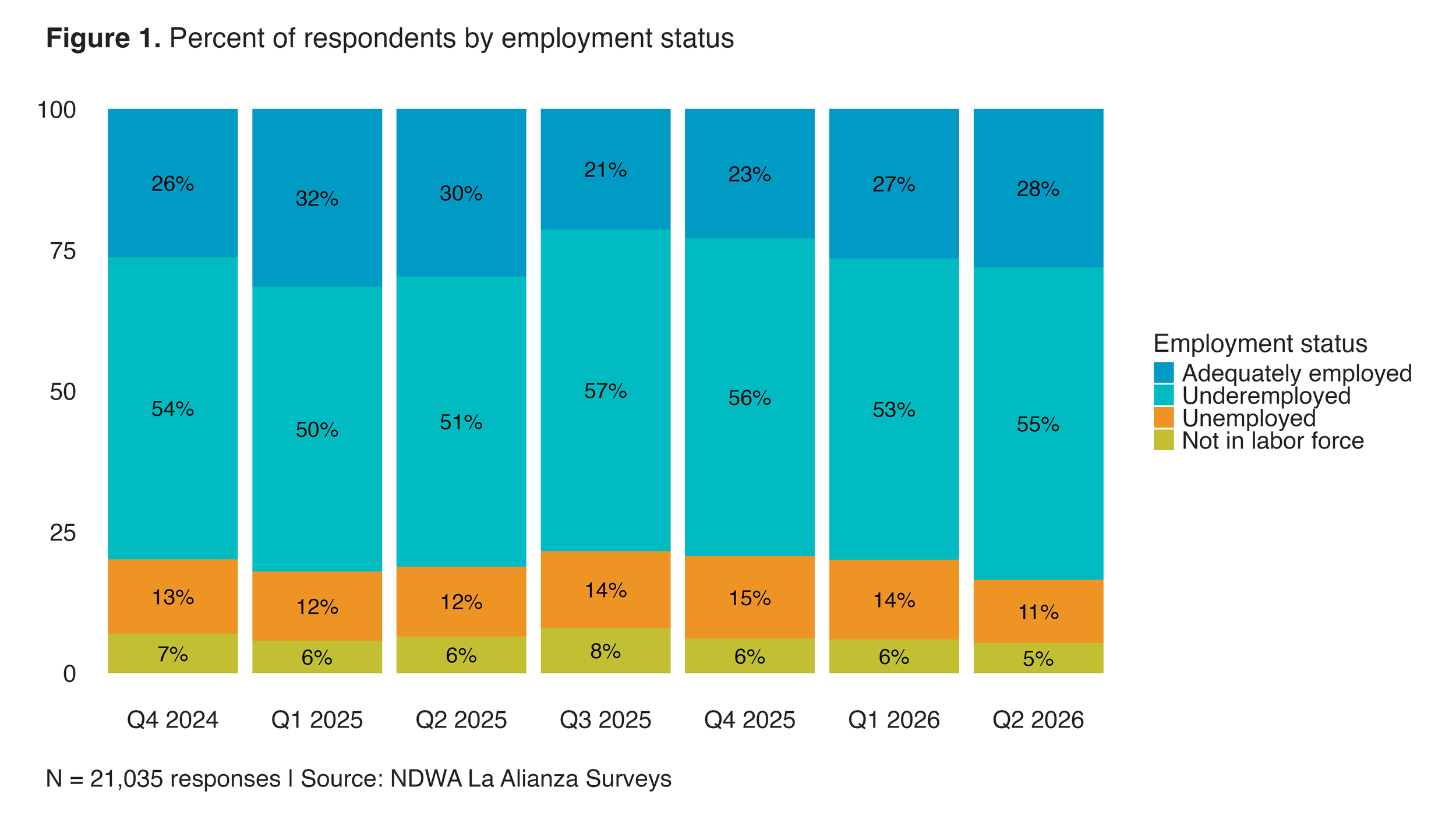
Unemployment fell from 14% in Q1 to 11% in Q2 2026. This decrease in unemployment was paired with minor increases in adequate employment and underemployment.
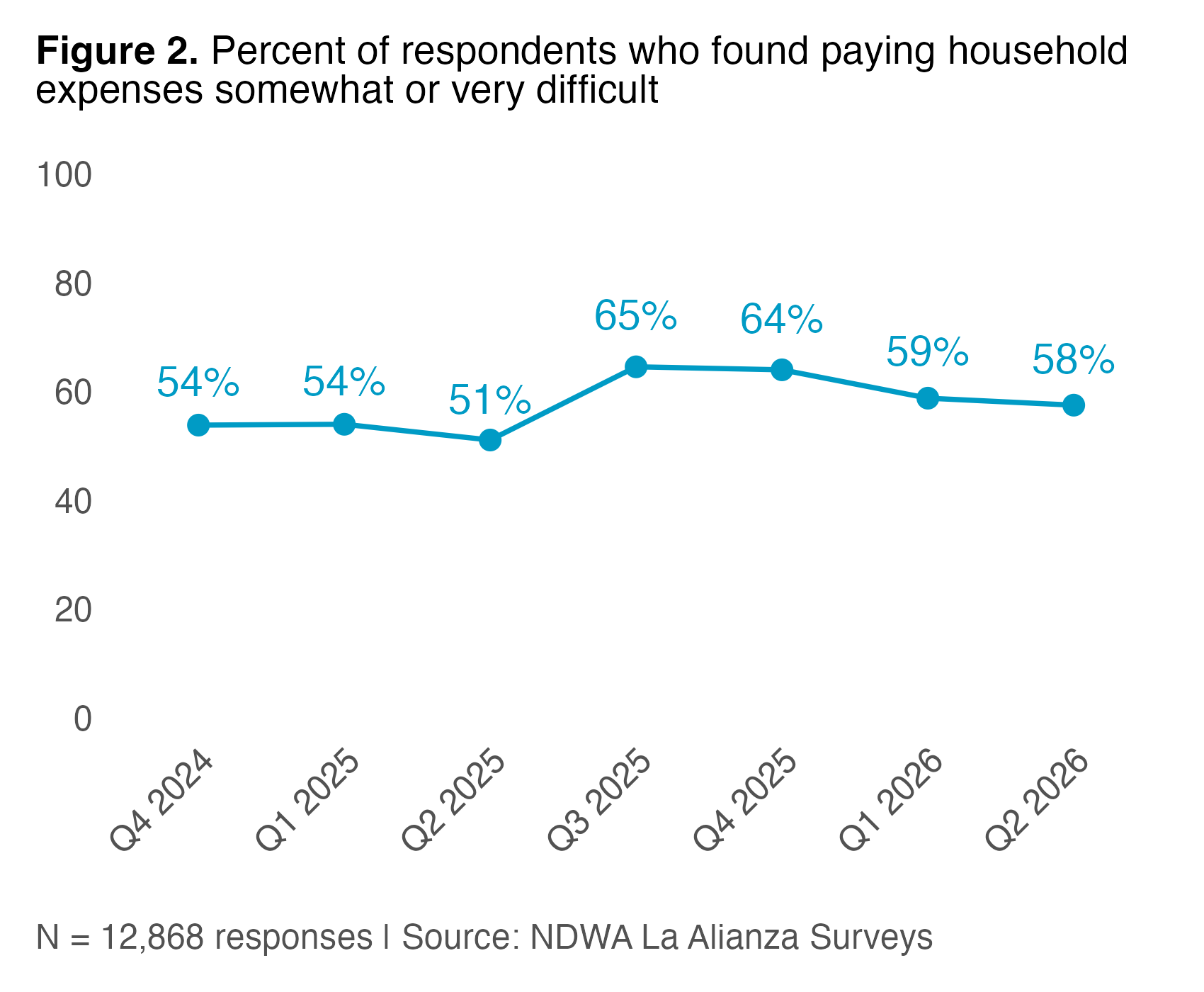
Economic insecurity was reported by nearly 6 in 10 domestic worker respondents in both the first (59%) and second (58%) quarters of 2026.
Workers consistently reported less say in workplace issues than they should have.
One in two domestic worker respondents reported poor psychological well-being.
Only 15% of domestic worker respondents had a written contract with an employer.
Data overview
This report analyzes 1,728 complete responses from 1,309 Spanish-speaking domestic workers to one or more of the 7 biweekly surveys conducted between April and June of 2026 (Q2 2026).
On April 22, 2026, NDWA learned of possible disruptions to the Facebook messaging functionality we rely on to collect survey data from our cohort of Spanish-speaking domestic workers. NDWA responded by issuing six broadcasts to all La Alianza subscribers between April 24-29 inviting them to join NDWA-owned communication platforms.
Although La Alianza messaging capabilities remained intact through the end of June, these repeated broadcasts may have hindered survey engagement. In Q2, La Alianza received 525 fewer completed responses from 424 fewer respondents than in Q1 2026.
Employment situation
Modest reduction in unemployment. Unemployment among Spanish-speaking domestic worker respondents fell from 14% in Q1 2026 to 11% in Q2. At the same time, the percent of respondents who found it somewhat or very easy to find or keep work in the last 14 days rose from 31% in Q1 2026 to 34% in Q2 2026.
This recent decrease in unemployment was paired with minor increases in adequate employment and underemployment (Figure 1). For example, the percent who were underemployed—meaning they worked fewer hours than they wanted—rose from 53% in Q1 2026 to 55% in Q2 2026. When asked why they couldn’t work more, 69% reported difficulties finding clients, an increase from 67% in Q1 2026. Eleven percent reported not feeling safe enough to look for work, consistent with Q1.
Finally, 43% of domestic worker respondents were paid $14 or less per hour in Q2 2026.
Economic security
Persistent economic vulnerability.
Economic insecurity was reported by nearly 6 in 10 domestic worker respondents in both Q1 (59%) and Q2 (58%) of 2026.
Fifty-two percent of respondents reported housing insecurity in both quarters, and food insecurity barely budged from affecting 82% of respondents in Q1 to 81% of respondents in Q2 2026.
Economic insecurity in Q2 2026 remained above levels from this time last year (Figure 2).
Worker voice
For the first time since Q2 2025, domestic worker respondents were asked about their voice in the workplace, measured as a voice gap. We measured worker voice across six workplace issues: wages, working conditions, being treated with respect, resolving disagreements, and deciding how to perform the work. Housecleaners were asked an additional question about voice when deciding which cleaning products to use. Nannies and home care workers were asked about voice when deciding the care and activities their clients need.
Key Definitions
Worker voice is defined as the ways in which workers attempt to have a say to influence issues that affect their work.
Voice gap is the difference between how much voice workers believe they ought to have and how much voice they actually have in the workplace.
Workers consistently reported less say in workplace issues than they should have. In Q2 2026, domestic worker respondents reported a mean voice gap of 2.1. Using a scale of 1 (I have what I ought to have) to 5 (no say), a mean voice gap of 2.1 places workers between a “little less” and “less” say in the workplace than they ought to have. In 2024 and 2025, domestic worker respondents reported a mean voice gap of 2.2. A higher number indicates a higher voice gap, meaning that workers feel they should have more say at work than they currently have.
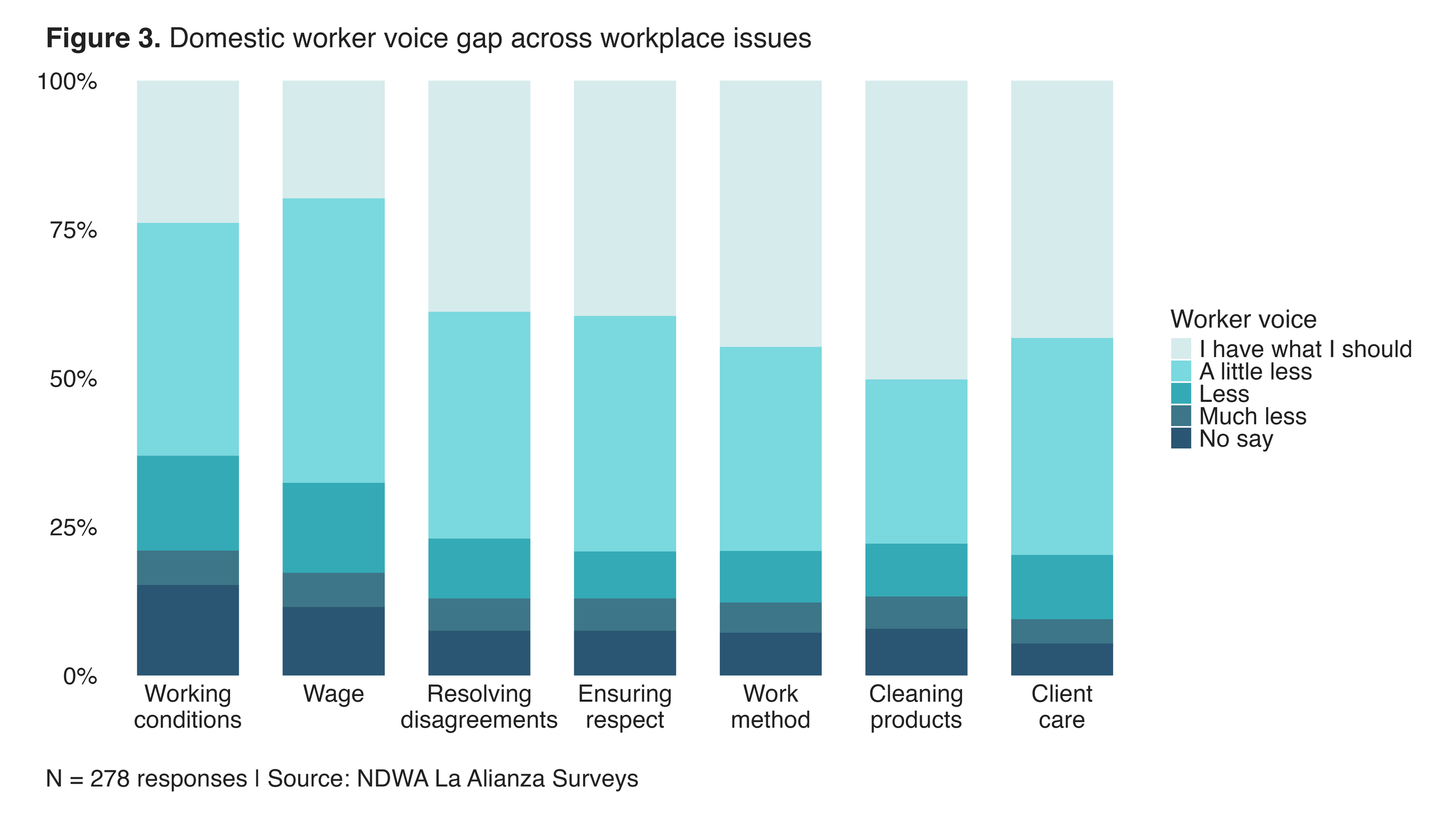
The largest voice gaps were related to working conditions and wages. Respondents reported a voice gap of 2.5 over working conditions, including hours, breaks, and benefits. They also reported a voice gap of 2.4 in setting their wages, meaning they have between a “little less” and “less” say over how much they get paid than they should have.
Compared to Q2 2025, respondents in Q2 2026 somewhat less often reported the highest and lowest levels of worker voice (i.e., "I have the voice I should have" or "No voice at all"). Instead, they more often reported middling levels of voice.
Mental health
One in two domestic worker respondents reported poor psychological well-being in Q2 2026. The World Health Organization advises that poor psychological well-being detected by this threshold be followed with further mental health screening. Since the start of 2025, 52% of respondents have reported poor psychological well-being, on average.
Job quality
The number of participants responding to questions on job quality fell by 25% between Q1 and Q2 2026. Findings below are limited to questions with at least 100 total respondents.
Only 15% of domestic worker respondents in Q2 2026 had a written contract with at least one employer. Fifty-seven percent of respondents felt either somewhat or very uncomfortable asking for a sick day, and 44% requested a sick day in the last 3 months.
In terms of rest and meal breaks, 40% of respondents “sometimes” took these breaks during the workday, 27% took them “regularly”, 24% took them “almost never”, and 9% “never” took rest and meal breaks. Nearly 9 in 10 respondents (89%) of respondents also reported “sometimes” or “regularly” feeling concerned about their health and safety at work in the last 3 months. Lastly, 36% of domestic worker respondents reported being treated disrespectfully at work either “sometimes” or “regularly” in the last 3 months.
Why this matters
In the second quarter of 2026, conditions for Spanish-speaking domestic workers were largely unchanged from last quarter. Nearly 60% of workers found it somewhat or very difficult to make ends meet, half reported poor mental health, and workers consistently reported having less say in workplace issues than they should have.
One positive signal emerged this quarter: unemployment fell by three percentage points compared to last quarter. Despite this important shift, unemployment among La Alianza survey respondents (11% in Q2 2026) remains far higher than the national unemployment rate and the unemployment rate among Hispanic women.
These persistent economic, employment, and mental health challenges underscore the need for continued engagement and surveying of domestic workers to identify and elevate their needs. As we look ahead, elevating the voices of domestic workers has never felt more timely.
Key terms
Employment status is defined using information on the number of hours worked in the last 7 days, attitudes towards hours worked, availability for work in the last 7 days, and whether a respondent looked for a job in the last 30 days:
Adequately employed: Worked >0 hours; Worked the number of hours they wanted or more hours than they wanted
Underemployed: Worked >0 hours; Wanted to work more hours than they did
Unemployed: Worked 0 hours; Available to work and tried to find work
Not in labor force: Worked 0 hours; Not available to work and/or did not look for work
Economic insecurity is defined as finding it somewhat or very difficult to pay regular household expenses, including food, rent or mortgage, car payments, and medical expenses.
Housing insecurity is defined as not being able to complete rent or mortgage payment on time in the last 30 days.
Food insecurity is defined as food in the household being somewhat or regularly scarce in the last 7 days.
Quartersare defined as follows: Q1 = January-March, Q2 = April-June, Q3 = July-September, and Q4 = October-December.